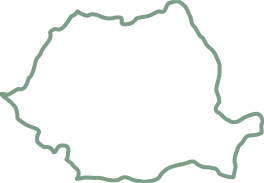
A national park is a natural area protected by law, created to safeguard and conserve entire ecosystems that are representative at national level, plant and animal species, natural landscapes and the balance of ecosystems, while allowing the public to visit and discover nature in its pure state. To protect these areas, human activities are regulated and intervention is kept to a minimum.
Protects crucial habitats and provides a safe refuge for thousands of plant and animal species.
The forests and intact ecosystems within the parks capture huge amounts of carbon dioxide and regulate the local microclimate.
Keeps ecosystems working properly, purifies the air and guarantees clean freshwater sources for entire regions.
Creates jobs in ecotourism, mountain guiding and hospitality services (guesthouses, local food spots).
Boosts the local economy by promoting crafts, traditional products and the region's distinctive architecture.
Protects the cultural heritage and historic landscape in which local communities have grown for generations.
National parks put the country on the world ecotourism map, attracting foreign visitors and investment.
Natural protection against floods, soil erosion and drought saves huge budgets that would otherwise go to post-disaster recovery.
Becomes a living laboratory that attracts funding for international scientific and educational projects.
National parks support a local economy and a whole ecosystem of services that help the local community earn a living.
National parks are true sanctuaries of nature, where the absolute priority is protecting biodiversity and human intervention remains minimal. In strictly protected zones — which ideally should cover 75% of the park's area — resource exploitation is forbidden.
Here you can enjoy ecotourism only on clearly defined trails, respecting the rules of the place. Even so, the park lives in harmony with people. In specially regulated zones, locals may continue traditional activities such as shepherding, while the surrounding communities are encouraged toward sustainable development and the responsible use of resources. This way, nature stays intact and the local villages keep developing.
Nature parks are created to protect rural or mountain landscapes where people and nature have coexisted in harmony over time — a balance that must be maintained in the long term. They also contain protected zones as well as areas where traditional human activities, the responsible use of natural resources and sustainable development are regulated and permitted.
Besides national and nature parks, the national network of protected areas includes other essential categories: nature reserves and scientific reserves, which protect more specific natural areas and features, with rules tailored to their preservation (rare plant and animal species, plant and forest communities, unique geological formations).
While scientific reserves have an extremely strict regime, open almost exclusively to researchers studying the natural evolution of species, nature reserves allow public access on well-defined trails, offering excellent opportunities for education and ecotourism.
Natural monuments are another special category, created to protect specific and unique natural features such as centuries-old trees, spectacular caves, narrow gorges or waterfalls of rare beauty. They act like open-air museums, where any activity that might destroy or alter the protected feature is strictly forbidden.
We invite you to discover these natural sanctuaries not merely as holiday destinations, but as experiences of a deeper connection with the environment, where every trail walked brings us closer to understanding the balance of nature. By visiting a national park, you not only recharge in the purest way possible, but also contribute directly to recognising and valuing our unique natural heritage. Share their beauty with your loved ones and inspire others to explore wild Romania responsibly!
The Făgăraș Mountains, the highest mountains in Romania, shelter some of the most valuable ecosystems in Europe: natural forests, alpine meadows and hundreds of rivers and streams that spring from their slopes.
Here live some of the continent's emblematic species – the wolf, the bear and the lynx – while the beaver, the bison and the griffon vulture have returned after a long absence. The local communities, settled all around them, are part of this nature.
Conservation Carpathia Foundation is working to create the Făgăraș Mountains National Park, a large-scale protected area, where nature can thrive and people can benefit from the opportunities brought by conservation, ecotourism and an economy that grows with nature, not against it.
With the support of local communities and the Romanian State, the Făgăraș Mountains can become one of the great nature-conservation success stories in Europe. A national park represents the highest level of protection for nature in Romania — a long-term investment in nature, in people and in the future. The Făgăraș Mountains deserve this recognition and this protection.